He came for capital, and we had to change his business plan
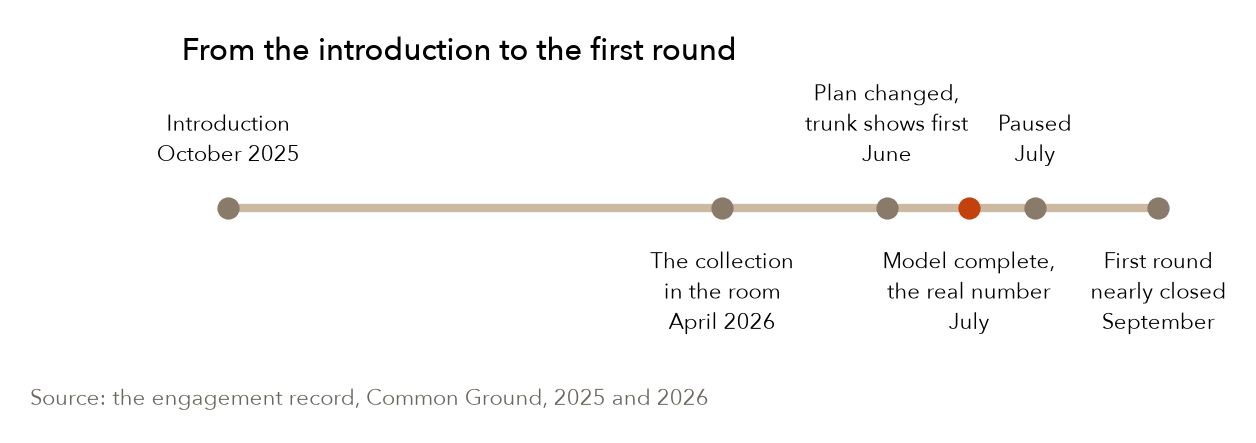
Jason Scott is a real designer. He is an established New York menswear designer whose work had already been on a magazine cover and on professional athletes, and he has a great fabric relationship. The Italian mills and made-to-order factories behind the line are his relationships, built on his own trips to Italy, where he worked with the mills on how the yarns are knit so that wool, cashmere and silk could do the work of a technical fabric. He came back with deposit terms and lead times, which turned out to be the most valuable inputs in the whole engagement. The product was the strongest thing in the room. When he brought the collection in person in April 2026 it was several times better in the hand than on the deck, and I said so.
The deck and his brand identity book are his original work, not ours (his deck and brand book, Attachments C and D, held pending review). They are the reference point, and what we built evolved from them. Reading the two side by side, we found a gap. What was very strong was the market segment he was going after, his brand relationships, and the materials and the product. What was very poor was the way the brand was shown: the identity, the deck and the collateral. That gap between a strong business and a weak picture of it is what we suggested he change, and C and D are the before of that visual work. The brand is public today at jasonscott.co, under the same line his deck opens with.
We were introduced in October 2025, for an investor conversation. He came to Common Ground for capital, and the raise had already been through several sizes. The wedge was the private club and the resort community, with wholesale doors in the pro shop first and a slow direct channel behind them. That is a reasonable way to size a round when the plan is the only thing you have. It is a placeholder wearing the clothes of a fact once a bottoms-up model exists, and none did.
The deck's numbers did not tie, and the raise number had been typed in at the top of the plan rather than built up from it.
Our capital partner held the raise mechanics through Prince Capital, the licensed placement advisor. Common Ground's job was the analytical core and the go-to-market plan, and it became more than a model. We had to really change his business plan: how he launched, where he sold first, how he handled returns, what he built in the first two years, and how much he asked for.
So the situation was a real designer with the right product and a plan built backward. The revenue number was too big and the capital number was too small, and both for the same reason: neither had been built from the unit up. He was not asking for enough money.
Build the plan from the door up, and let it disagree
I listened first. If the fix had been obvious he would have made it already, and it is almost never what the person asking thinks it is. The ask was capital. The rock in the stream was the plan underneath the ask, and the raise number typed in at the top of it.
The obvious move inside a live raise is to validate the number already in motion. A top-down check on a locked round takes a week and offends nobody. I did not do that, for a narrow reason: a model built to confirm a number cannot tell you when the number is wrong, and the whole value of the work was in being able to say so before an investor's own diligence said it for us.
So the model was built with no inherited number in it. Ten chassis, every colorway, every door in a library of 193 accounts across eight channels, each door tagged with a tier, a target activation year and payment terms, each buy exploded through a size curve to the unit. Revenue rolled up from there through the channel to the profit-and-loss statement and then through cash timing to a capital need. The raise number fell out at the end, where it belongs.
The second decision was about honesty of a specific kind. A sophisticated investor's first objection to a model this size is that it can be made to say anything with enough tabs. The answer is not that the model is right; it is checkable at three seams: every input is flagged by how well it is known, the headline revenue ties four independent ways, and the capital need is stress-tested rather than presented as a point. I led with the Assumptions Log on purpose, because a model that admits which of its inputs are placeholders is the only kind a careful reader trusts.
The third decision was where the finding went. When the cash-flow tab came out above the raise, the memo could have carried that in a risks section near the back. It went first instead. Stating it plainly, to a founder and a capital partner who had both already said the number out loud, carried a real cost, and I paid it.
How I came at this one
The question under everything he said was whether he was asking for enough. The raise number came from a plan target, so the plan had to be rebuilt from the unit up with no inherited number in it. The second question was whose incentive the anchored number served: his, ours, and every investor who had heard it, which is why the finding went first.